PAH Growth Models#
Four PAH growth models are implemented in Omnisoot to describe the conversion of PAHs into incipient particles and their adsorption onto existing agglomerates. In other words, these models determine the inception source terms, \(I_{\varphi,\mathrm{inc}}\), and the section-specific PAH-adsorption source terms, \(I_{\varphi,\mathrm{ads}}^i\).
The implemented models are Irreversible Dimerization [29], Reactive Dimerization [30], Dimer Coalescence [31], and E-Bridge Modified [32]. All four models are based on PAH collisions, as supported by extensive evidence in the literature [33, 34, 35], but they differ in reversibility, temperature dependence, and the number of steps involved.
The collision frequency of gaseous species, including PAH molecules and polymers, depends on their mass and diameter and is calculated as
Here, 2.2 is the van der Waals enhancement factor [30]. The reduced diameter, \(d_r\), and reduced mass, \(m_r\), of two PAH molecules or dimers are calculated as
The mass, \(m_{\mathrm{PAH}_j}\), and equivalent diameter, \(d_{\mathrm{PAH}_j}\), of PAH molecule \(j\) are obtained as
The equivalent PAH density, \(\rho_{\mathrm{PAH}_j}\), is estimated using the relation proposed by Johansson et al. [36]:
Here, \(n_{C,\mathrm{PAH}_j}\) and \(n_{H,\mathrm{PAH}_j}\) denote the numbers of carbon and hydrogen atoms in PAH molecule \(j\), respectively.
The collision frequency between \(\mathrm{PAH}_j\) and soot agglomerates in section \(i\) is calculated over the entire Knudsen-number range using the harmonic mean of the free-molecular and continuum collision frequencies:
Here, \(C^i\) is the Cunningham correction factor calculated using Equation (35).
Irreversible Dimerization#
The Irreversible Dimerization model is based on the collision of two PAH molecules to form a dimer. Sequential growth can continue through the formation of trimers, tetramers, and larger clusters until the PAH-cluster mass reaches a threshold at which it is treated as a solid particle. For practical purposes, a dimer is commonly treated as an incipient particle that subsequently grows through surface reactions and coagulation.
The collision of two identical PAH molecules forms a new dimer:
Similarly, adsorption of a PAH molecule onto a soot particle is represented by an irreversible collision:
The forward rate coefficients for dimerization, \(k_{f,\mathrm{dim},j}\), and adsorption, \(k_{f,\mathrm{ads},j}^i\), in Reactions (87) and (88) are calculated as
Here, \(\beta_{jk,\mathrm{PAH}}\) and \(\beta_{\mathrm{ads},j}^i\) are calculated using Equations (78) and (84), respectively. The parameters \(\gamma_{\mathrm{inc}}\) and \(\gamma_{\mathrm{ads}}\) are the collision efficiencies for dimerization and adsorption. Their values range from \(10^{-7}\) to 1 and are typically selected by comparing predicted soot properties with experimental measurements.
The dimerization rate of \(\mathrm{PAH}_j\) is
The inception contributions to the source terms are
The PAH-adsorption rate in section \(i\) is
The PAH-adsorption contributions to the source terms are
PAH adsorption is a mass-growth process that changes only \(C_{\mathrm{tot}}\) and \(H_{\mathrm{tot}}\) and does not directly change \(N_{\mathrm{agg}}\) or \(N_{\mathrm{pri}}\). Each PAH molecule loses one hydrogen atom to become a radical, which then forms a bond with a dehydrogenated site on the soot surface. Therefore, two hydrogen atoms are released during adsorption, as accounted for in Equation (97).
Dimer formation consumes two PAH molecules, whereas adsorption removes one PAH molecule from the gas mixture. The rates of removal of \(\mathrm{PAH}_j\) are
One \(\mathrm{H_2}\) molecule is released to the gas mixture during each adsorption event:
Reactive Dimerization#
Reactive Dimerization builds on Irreversible Dimerization, with the key difference that the first steps of dimerization and adsorption are reversible. These steps form physically bonded dimers or physically adsorbed PAHs, followed by irreversible carbonization that creates chemical bonds [30]. The model allows the formation of both homo- and heterodimers.
Dimerization of \(\mathrm{PAH}_j\) and \(\mathrm{PAH}_k\) is represented as
Here, \(\mathrm{Dimer}_{jk}^{*}\) and \(\mathrm{Dimer}_{jk}\) are physically and chemically bonded dimers, respectively.
The forward rate coefficient for physical dimerization is
Here, \(\beta_{jk,\mathrm{PAH}}\) is calculated using Equation (78), and \(p^{\prime\prime}=0.1\) represents the probability that a PAH–PAH collision occurs in the “FACE” configuration and successfully forms a van der Waals bond [37].
The reverse rate coefficient is obtained from the dimerization equilibrium constant [38]:
The parameters are \(a=0.115\), obtained from pyrene-dimerization data [39]; \(b=1.8\) [30]; \(c=933420\) J/kg; and \(d=34053\) J/mol [30].
The rate coefficient for chemical-bond formation is written in Arrhenius form [40]:
Assuming a steady-state concentration of physical dimers,
the rate of formation of chemically bonded dimers is
The inception contributions to the source terms are evaluated by summing over all PAH-precursor combinations:
PAH adsorption is represented by a two-step process in which collision of \(\mathrm{PAH}_j\) with a soot agglomerate first produces physically bonded \(\mathrm{Soot{-}PAH}_j^{*}\), which then carbonizes to form chemically bonded \(\mathrm{Soot{-}PAH}_j\):
The forward and reverse rate coefficients for PAH–soot association are
Here, \(\beta_{\mathrm{ads},j}^i\) is calculated using Equation (84), and \(a\), \(b\), \(c\), and \(d\) have the same values as in the inception formulation. Calculation of \(\epsilon_{\mathrm{soot},j}^i\) requires an equivalent soot molecular weight, estimated from the carbon mass of each agglomerate as
The carbonization rate coefficient for \(\mathrm{Soot{-}PAH}_j^{*}\) is written in an Arrhenius form similar to Equation (108). Its pre-exponential factor was adjusted by matching a numerical particle-size distribution [40] to measurements from ethylene pyrolysis in a flow reactor [41]:
Assuming a steady-state concentration of physically adsorbed PAHs, the total adsorption rate is calculated similarly to the inception flux in Equation (109):
The PAH-adsorption contributions to the source terms are
The rates of removal of \(\mathrm{PAH}_j\) from the gas mixture through inception and adsorption are
One \(\mathrm{H_2}\) molecule is released during each adsorption event:
Dimer Coalescence#
The Dimer Coalescence model is a multistep irreversible model proposed by Blanquart and Pitsch [31]. Self-collision of PAH molecules forms dimers, which represent an intermediate state between gaseous PAH molecules and solid soot particles. The dimers can either form incipient soot particles through self-coalescence or adsorb onto existing soot particles and contribute to surface growth. The inception and surface-growth formulation presented here follows Sun et al. [42].
The dimerization and inception rate coefficients are calculated from PAH and dimer collision frequencies:
Both \(\beta_{jj,\mathrm{PAH}}\) and \(\beta_{jj,\mathrm{dimer}}\) are calculated using Equation (78). The dimerization efficiency is assumed to scale with the fourth power of PAH molecular weight [10]:
Blanquart and Pitsch [31] estimated \(C_{N,j}\) by comparing calculated PAH profiles with measurements from a premixed benzene flame [43]. Values for several PAHs are listed in Table 1 of Blanquart and Pitsch [10].
The dimer-collision rate is
The rate of dimer adsorption onto soot particles is
Assuming rapid dimer consumption yields a steady-state dimer concentration, which is obtained by solving the quadratic equation [10]:
Here, \(a_{\mathrm{inc},j}=k_{\mathrm{inc},j}\), and \(b_{\mathrm{ads},j}\) is obtained by summing the dimer-adsorption rates over all sections:
After the dimer concentration has been determined, the inception and adsorption contributions to the soot-variable source terms are calculated by accounting for the numbers of carbon and hydrogen atoms involved:
The rates of PAH removal and \(\mathrm{H_2}\) release are
E-Bridge Modified#
The E-Bridge model was originally proposed by Frenklach and Mebel [32] to describe soot inception through a HACA-like sequence. It begins with dehydrogenation of PAH monomers, commonly pyrene, to form monomer radicals. Sequential radical addition then forms dimers, trimers, and larger polymers until the PAH structure reaches a mass threshold at which clustering becomes irreversible [32].
Omnisoot uses a modified formulation, called E-Bridge Modified, in which dimers are treated as incipient soot particles and monomer radicals adsorb onto soot agglomerates. The model is represented by the following pathways:
The rate coefficients for Reactions (144) and (145) are listed in Table 1. The dimer-formation and PAH-adsorption rate coefficients are
Here, \(\beta_{jj,\mathrm{PAH}}\) and \(\beta_{\mathrm{ads},j}^i\) are obtained using Equations (78) and (84), respectively. The dimer-formation and adsorption rates are
Some filler text
Reaction |
Direction |
\(A\) [\(\mathrm{m^3\,mol^{-1}\,s^{-1}}\)] |
\(n\) |
\(E/R\) [K] |
|---|---|---|---|---|
Forward |
\(98\,n_{C,\mathrm{PAH}_j}\) |
1.8 |
7563.519 |
|
Reverse |
\(1.6\times10^{-2}\) |
2.63 |
2145.346 |
|
Forward |
\(4.8658\times10^7\) |
0.13 |
0 |
Calculation of inception and adsorption rates requires the concentration of \(\dot{\mathrm{PAH}}_j\). Applying the steady-state approximation,
gives the quadratic equation
The radical concentration is then
The inception source terms, \(I_{\varphi,\mathrm{inc}}\), are
The PAH-adsorption source terms, \(I_{\varphi,\mathrm{ads}}^i\), are
The rates of removal of each PAH through soot inception and PAH adsorption, and the rate of \(\mathrm{H_2}\) release to the gas mixture, are
Summary of Features#
A comparison of the key features of the implemented PAH growth models is provided in Table 2. As shown in Fig. 6, the inception fluxes predicted by the Reactive Dimerization and E-Bridge Modified models increase exponentially with temperature, or decrease with inverse temperature. In contrast, the Irreversible Dimerization and Dimer Coalescence models predict only an approximately twofold increase over the temperature range from 500 to 2500 K.
Model |
Reversibility |
Temperature dependence |
Inception sequence |
|---|---|---|---|
Irreversible Dimerization [29] |
Irreversible |
Weak, \(\propto\sqrt{T}\) |
\(\mathrm{PAH}\xrightarrow{\mathrm{collision}}\mathrm{Dimer}\) |
Reactive Dimerization [30] |
Reversible |
Strong, \(\propto\exp[-E/(RT)]\) |
\(\mathrm{PAH}\overset{collision}{\rightleftharpoons}\mathrm{Physical\ Dimer}\xrightarrow{\mathrm{carbonization}}\mathrm{Chemical\ Dimer}\) |
Dimer Coalescence [10] |
Irreversible |
Weak, \(\propto\sqrt{T}\) |
\(\mathrm{PAH}\xrightarrow{\mathrm{collision}}\mathrm{Dimer}\xrightarrow{\mathrm{collision}}\mathrm{Tetramer}\) |
E-Bridge Modified [32] |
Reversible |
Strong, \(\propto\exp[-E/(RT)]\) |
\(\mathrm{PAH}\overset{dehydrogenation}{\rightleftharpoons}\mathrm{Radical}\xrightarrow{\mathrm{collision}}\mathrm{Chemical\ Dimer}\) |
“Physical Dimer” and “Chemical Dimer” denote physically and chemically bonded dimers, respectively.
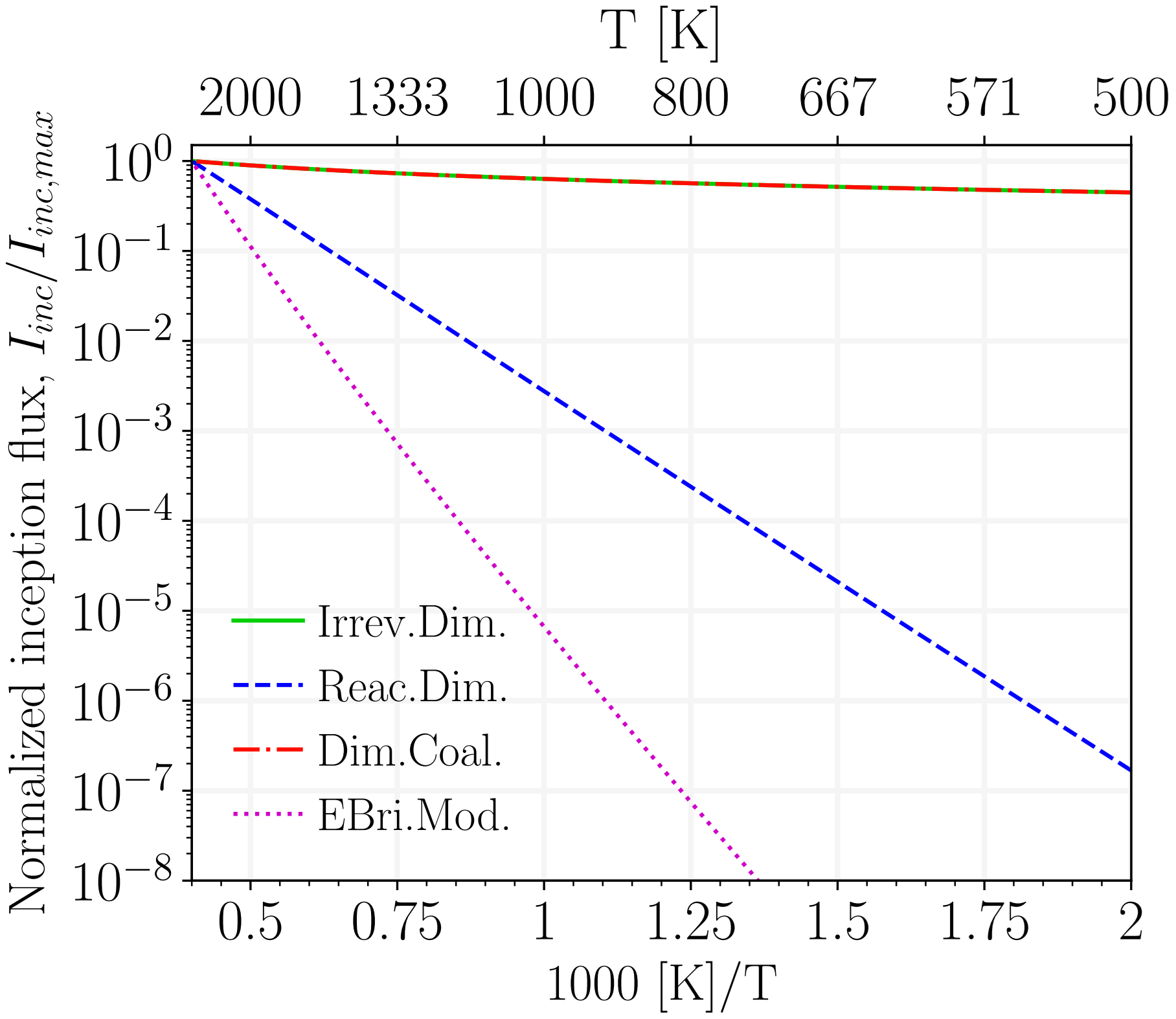
Fig. 6 Temperature dependence of the inception flux, \(I_{\mathrm{inc}}\), predicted using the implemented PAH growth models. The inception flux predicted by each model is normalized by its maximum value to facilitate comparison.#